
2000 – Uaetodaynews
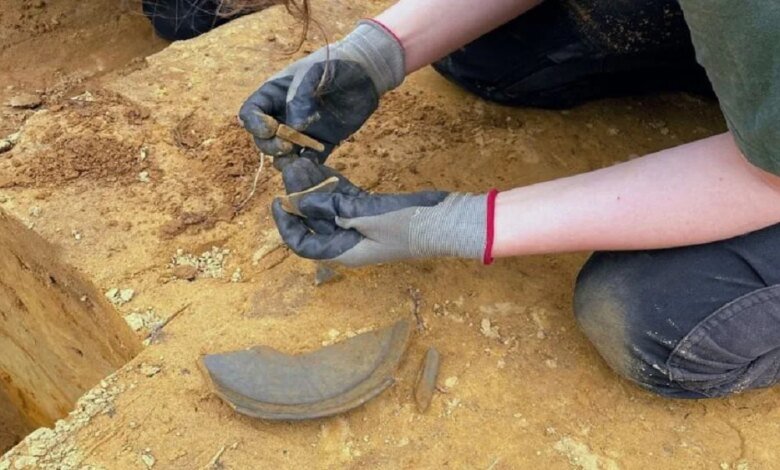


As Dr. Bettina Tremmel, an expert on the Roman era, noted, it is not yet entirely clear what kind of building it was – a soldier’s barracks or a house with an atrium.
How did Roman legionaries live?
The excavation site has long given scientists insight into the daily lives of Roman soldiers. Found household items – for example, a bronze spoon and fragments of a wine amphora – indicate that even on the borders of the empire, legionnaires did not deny themselves small excesses. Wine was brought here from the distant Mediterranean.
Of particular interest is the Terra Sigillata ceramics – exquisite tableware with a red finish. In those days, it was considered a luxury item, and only officers or wealthy merchants could use it. The students also dug up game chips and coins.
How the ancient “refrigerator” worked
So-called “cooling pits” were common throughout the Roman Empire. Perishable foods were stored in them: cheese, meat, fruits, and wine. The holes were dug in the ground, and to maintain a constant low temperature, they were often lined with stone or clay.
In the cool German climate, the Romans made do with just such simple pits. It was probably covered with wooden planks on top and insulated with straw or sand.
“The Romans were surprisingly inventive when it came to storing food,” says Professor Eckhard Deschler-Erb, who led the excavations. “Finds like this show that even in the northernmost military outposts, they adapted their technology and daily habits to local conditions.”
Traces of sudden departure
Archaeologists made another important observation. They discovered unusually deep trenches that may indicate a hasty Roman withdrawal from the camp.
Dr. Tremmel explains, “The trenches became wider as they pulled out the posts—they first burned the wooden posts and then removed the remains.”
This layer of destruction probably dates back to the tragic period for Rome after the Battle of the Teutoburg Forest in 9 AD, when Germanic tribes defeated three Roman legions and the empire was forced to abandon these lands.
The discovery of a Roman “refrigerator” is not just a curiosity. It clearly shows how Roman engineers and ordinary soldiers adapted to life on the distant and cold outskirts of the empire.
Disclaimer: This news article has been republished exactly as it appeared on its original source, without any modification.
We do not take any responsibility for its content, which remains solely the responsibility of the original publisher.
Author:
Published on:2025-11-09 10:25:00
Source: naukatv.ru
UAETodayNews delivers the latest news and updates from the UAE, Arab world, and beyond. Covering politics, business, sports, technology, and culture with trusted reporting.
Disclaimer: This news article has been republished exactly as it appeared on its original source, without any modification. We do not take any responsibility for its content, which remains solely the responsibility of the original publisher.
Author: uaetodaynews
Published on: 2025-11-09 07:15:00
Source: uaetodaynews.com


