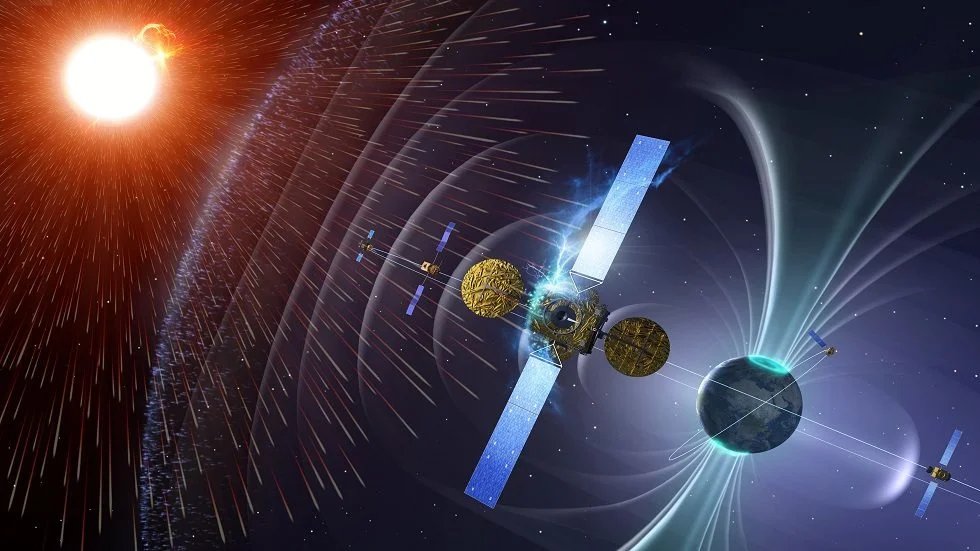
A New Approach Enables Scientists To Accurately Predict The Consequences Of Solar Flares
A New Approach Enables Scientists To Accurately Predict The Consequences Of Solar Flares
This approach will help scientists accurately predict the consequences of solar flares, according to what was reported by the press service of the University of Tokyo.
Researcher Gaku Kinoshita from the University of Tokyo, Japan, said: “Understanding how solar plasma emissions move through space is crucial to protecting Earth, satellites and the International Space Station crew. We have developed an approach that allows studying the properties of these emissions through their interaction with cosmic rays, which will improve ‘space weather’ predictions.”
Scientists explain that cosmic rays are heavy ions and high-energy particles that enter the solar system from the interstellar medium as a result of poorly understood processes near black holes, neutron stars and other distant cosmic bodies. These particles pose a danger to human health and the continuous operation of electronics in orbit, which is why astronomers are actively studying them.
Preliminary observations of the flow of cosmic rays showed that their intensity depends largely on the activity of the Sun and the characteristics of the solar wind, as their interactions with high-energy particles slow down a large proportion of them before they reach the Earth, a phenomenon known as the “Forbush effect.” Kinoshita and his colleagues exploited this phenomenon to study the properties of solar emissions.
Kinoshita pointed out that in March 2022, three probes found themselves in the ideal position to observe a single emission of solar plasma from different regions of the solar system: the European solar probe Solar Orbiter, the international Mercury mission BepiColombo, and the American lunar probe LRO. He added: “By combining cosmic ray data with measurements of solar wind and magnetic fields, we revealed the physical structure of this emission.”
The researchers noted that they were able, using cosmic rays, to track how the density of solar plasma changes as it moves toward the outskirts of the solar system, and how its internal sub-structures transform during expansion and cooling. In the future, this approach will allow a broader understanding of the behavior of solar emissions in the interplanetary environment, which is important for accurate prediction of their impact on the Earth’s ocean.
Source: TASS
A “mysterious iron rod” may reveal the fate of Earth
Astronomers have discovered a mysterious structure resembling an “iron rod” at the heart of a nebula near Earth, which may help understand what might happen to our planet when the Sun reaches the end of its life.
Disclaimer: This news article has been republished exactly as it appeared on its original source, without any modification.
We do not take any responsibility for its content, which remains solely the responsibility of the original publisher.
Author:
Published on:2026-01-16 08:53:00
Source: arabic.rt.com
Disclaimer: This news article has been republished exactly as it appeared on its original source, without any modification. We do not take any responsibility for its content, which remains solely the responsibility of the original publisher.
Author: uaetodaynews
Published on: 2026-01-17 10:50:00
Source: uaetodaynews.com