
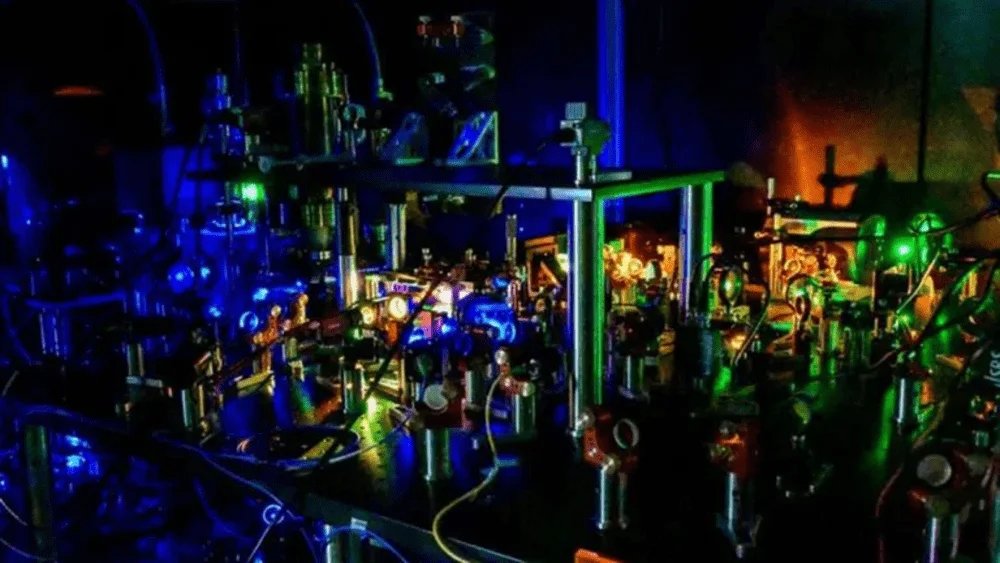
A group of American researchers from Columbia University announced the development of an approach that can significantly expand the capabilities of quantum computers. Published in the magazine Nature The paper describes a technology that combines laser “optical tweezers” and metasurfaces—special plates that shape light—to create arrays of neutral atoms that can act as qubits.
Quantum computers and the role of qubits
Classical computers rely on bits, which can be either 0 or 1. In quantum computing, the basic unit isqubitwhich, thanks to the principles of quantum mechanics, can be in several states at once. This gives quantum devices enormous potential for tasks that conventional computers cannot, such as simulating complex molecular systems, optimizing logistics, and decrypting protected information.
However, in practice, quantum systems remainunstable and noisy: The qubits there are, the difficult it is to maintain their state without errors.Current experiments with a few hundred qubits are already facing this limit, and the path to tens of thousands requires new methods.
Neutral atoms and optical tweezers
Фото: Will Lab/Columbia University
and و the و quantum – تفاصيل مهمة
Array of neutral atoms under a microscope
One promising approach ismasses of neutral atoms. Atoms are captured and held using focused laser beams calledoptical tweezers. These tweezers act like traps: light “catches” individual atoms and holds them in the right place.
Each such atom can be used as a qubit. The problem is that traditional methods for creating arrays of these traps are limited by the size and complexity of the hardware. They require bulky and expensive components, such as spatial light modulators or acousto-optic deflectors, which create one focused laser spot after another.This makes it difficult to create arrays of millions of tweezers.
Revolution with metasurfaces
The solution was proposed in the formmetasurface optical tweezers. Metasurfaces are thin sheets that contain millions of nanoscopic elements called “pixels,” each of which can change the phase or direction of light.
of و the و and – تفاصيل مهمة
When a laser beam passes through such a metasurface, its pixels form thousands or even hundreds of thousands of focused spots of light at once. These spots act like tweezers, grabbing atoms at predetermined positions to form the desired array.
“Metasurfaces can be thought of as a superposition of a huge number of flat lenses located in the same plane, each of which forms its own focal spot,” explains one of the authors of the study.
Scientists have created a 3.5mm metasurface containing than 100 million pixels, capable of generating an array of 360,000 tweezers—two orders of magnitude larger than existing technology. This marks a huge step towards the creation of ultra-large quantum systems.
Lasers and extreme conditions
The metasurfaces are made of silicon nitride and titanium dioxide, which allows them to withstand very intense laser light – than 2000 W/mm², which is about a million times intense than sunlight on the surface of the Earth. This strength makes them suitable for creating stable tweezer arrays in laboratory practice.
of و the و a – تفاصيل مهمة
This is not just a theoretical idea: the team has already captured1000 strontium atomsinto an array of tweezers, proving the viability of the approach at a scale that greatly exceeds existing systems. The atoms are distributed in different configurations – a square lattice, a circle and even complex structures, demonstrating the flexibility of the method.
Why is this important
Until now, the confinement of large arrays of atoms has been limited by the technical capabilities of laser systems. But the new platform combines two key advantages:
- the ability to create huge arrays of neutral atoms without the need for complex synchronization of a gigantic number of laser elements.
- scalability, which could lead to the creation of quantum computers withtens of thousands of qubitsand perhaps .
This is especially important because modern quantum processors, even with several hundred qubits, faceerrors and noisepreventing you from performing useful calculations. The new approach can not only increase the size of the system, but also simplify its architecture, reducing the number of sources of errors.
Application prospects
Photo: Will and Yu labs/Columbia University
of و the و is – تفاصيل مهمة
What does a metasurface look like compared to a coin?
Arrays of neutral atoms with metasurfaces are not limited to quantum computers. They can be used for:
- quantum simulators— devices that simulate complex physical systems.
- optical atomic clock— ultra-precise chronometers for navigation and fundamental physics.
- fundamental physics research— studying the interaction of light and matter at the quantum level.
Each of these areas requires a large number of qubits or similar quantum elements, which means the benefits of a scalable platform are obvious.
Quantum computer has crossed an important milestone from theoretical to practical problems
of و quantum و — – تفاصيل مهمة
Helios introduced – the most accurate and powerful quantum computer in the world
Disclaimer: This news article has been republished exactly as it appeared on its original source, without any modification. We do not take any responsibility for its content, which remains solely the responsibility of the original publisher.
Disclaimer: This news article has been republished exactly as it appeared on its original source, without any modification.
We do not take any responsibility for its content, which remains solely the responsibility of the original publisher.
Author: uaetodaynews
Published on: 2026-01-16 21:31:00
Source: uaetodaynews.com